You’ve been building backlinks. Submitting guest posts. Chasing domain authority scores.
And your rankings? Stuck.
Here’s what nobody is saying clearly enough: off page SEO has fundamentally changed. The strategies that moved the needle in 2021 are no longer the full picture — and in some cases, the way most people approach off-page work is actively wasting their time.
This isn’t a checklist of tactics. It’s a clear-eyed breakdown of what off page SEO actually means in 2026, what’s driving rankings now, and how to build authority that holds — in Google search and in AI-generated answers.
If you’ve already got your on-page foundations sorted (and if not, our on-page SEO guide covers every step), this is where the real competitive edge lives.
Table of Contents
What Off-Page SEO Actually Means Now
Off page SEO refers to everything that happens outside your website that influences how Google perceives your authority, trustworthiness, and relevance. The classic definition focused almost entirely on backlinks — the more sites that linked to you, the more Google trusted you. That was accurate for a long time.
It’s no longer the full story.
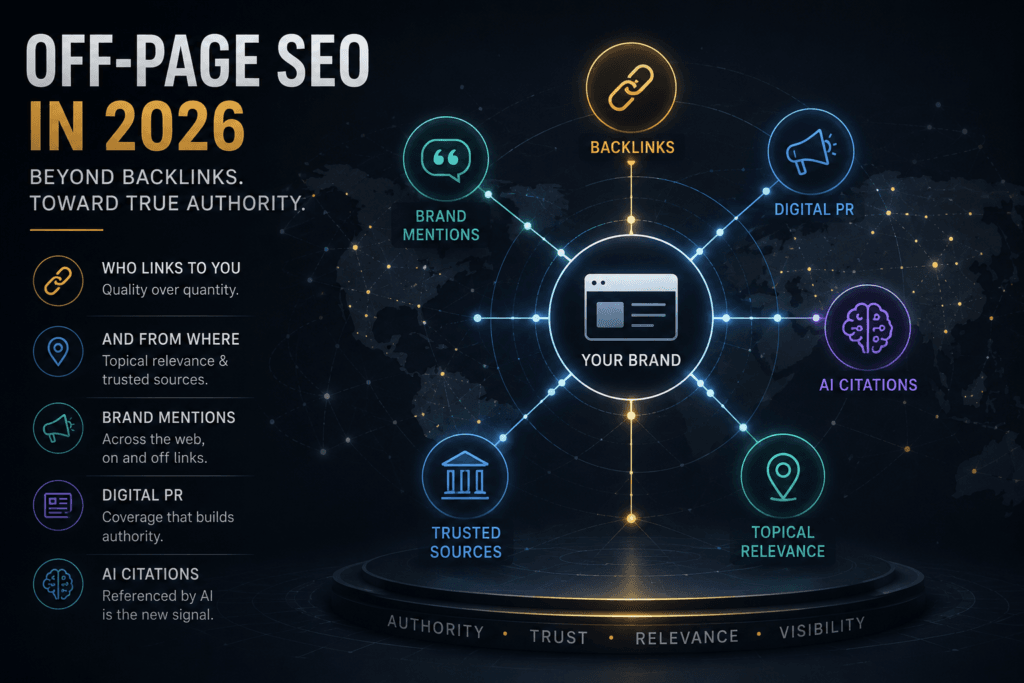
In 2026, Google’s systems are evaluating your site’s off-page presence across a much wider set of signals:
Who links to you — and from where. Quality over quantity has never mattered more. A single editorial link from a respected industry publication outweighs hundreds of links from low-traffic directories.
Who mentions you — even without a link. Google can now identify brand mentions across the web using natural language processing and connect them to your entity. Unlinked citations from credible sources carry measurable weight.
How your brand appears in AI-generated answers. As search increasingly routes through AI Overviews, Perplexity, and ChatGPT, being cited by these systems is becoming a distinct off-page SEO signal in its own right.
Your E-E-A-T footprint across the web. Experience, Expertise, Authoritativeness, and Trustworthiness are no longer measured only on your own pages. They’re validated by what other credible sources say about you.
This is the shift that most off page SEO guides are still catching up to. Off-site authority is no longer about accumulating links — it’s about building a verifiable digital reputation.
Is Link Building Still Worth It?
Yes. Categorically yes.
Backlinks remain one of the strongest off page SEO signals Google uses. According to research by Ahrefs on linking domains and search traffic, there is still a 0.82 correlation between the number of unique referring domains pointing to a site and its organic search traffic. That’s not a weak relationship. Links matter — they just don’t work the way most people think.
The mistake isn’t building links. The mistake is building the wrong links, in the wrong way, while ignoring everything else.
Here’s what link building in 2026 actually requires:
Topical relevance is non-negotiable. A backlink from an industry-adjacent site passes far more value than a high-DA link from a completely unrelated niche. Google’s AI models analyze the semantic relationship between the linking page and your page. A cooking blog linking to your SaaS review barely registers. A respected tech publication linking to your same SaaS review is gold.
Volume thinking is dead. Chasing hundreds of links from low-quality sources doesn’t just fail to work — it can actively harm your off page SEO profile. Google’s spam detection has grown sophisticated enough to identify mass link schemes, and the penalty isn’t always obvious. Rankings erode slowly, and attribution to bad link building is nearly impossible to see until significant damage is done.
The best links are earned, not built. The off-page SEO strategies generating the strongest results right now are ones where you create something genuinely worth linking to — original research, proprietary data, a free tool, an exhaustive guide on a topic nobody else has covered properly — and then promote it to the right publications and communities.
Authority gap analysis matters more than raw link counts. The real off page SEO question isn’t “how many links do I have?” It’s “what’s the authority gap between me and the sites ranking above me?” If your competitors are being cited by major industry publications and you aren’t, no amount of on-page optimization closes that gap. You need off-site authority — and building it is a deliberate, long-term project.
Link building is alive. But it’s evolved from a volume game into a reputation game. Those aren’t the same thing.
Brand Signals: The Ranking Factor Most Sites Ignore
Brand signals are one of the most powerful — and most underused — levers in off page SEO right now.
A brand signal is any external indication that your brand exists, is recognized, and is associated with specific topics. It includes unlinked mentions, branded searches, social media presence, review profiles, and entity consistency across directories and profiles.
Here’s why this matters.
Google’s AI systems are built around the concept of entities — real-world people, organizations, and things that the Knowledge Graph understands. If Google’s systems can recognize your brand as a verified entity, you earn a trust buffer. Your content gets indexed faster. Minor algorithm volatility affects you less. You’re treated as a credible source rather than an anonymous website.
Brands that rank consistently in 2026 aren’t just producing good content. They’re building an off-page presence that confirms to Google — and increasingly to AI systems — that they are a real, trusted, expert organization.
What builds brand signals for off page SEO:
Consistent NAP (Name, Address, Phone) information across all directories and listings signals legitimacy to both Google and local search systems. Inconsistencies — different business names across platforms, outdated addresses — actively weaken your off-site entity profile.
Branded search volume tells Google that users specifically want your perspective. When someone searches “[Your Brand] SEO tips” rather than just “SEO tips,” that’s a signal of genuine authority. You build branded search volume through visibility — social media, community participation, media coverage, and consistently producing content that gets attributed back to your brand name.
Unlinked brand mentions on high-authority platforms build topical association. If your brand name frequently appears near specific topics on credible external sites — even without a hyperlink — Google’s NLP models register the relationship. You become associated with that topic space in the way that editorial links used to create that association alone.
Reviews and reputation across third-party platforms (Google Business Profile, G2, Trustpilot, industry-specific review sites) contribute to off page SEO in ways that most technical SEO guides undercount. These signals validate your credibility to Google in ways that internal content cannot.
Brand signals are not quick wins. They compound. The brands that dominate search results in 2026 started building their off-site entity presence years ago — and the ones who started late are now scrambling to catch up.
E-E-A-T and Off-Page SEO: Why Your Content Isn’t Enough
You’ve heard of E-E-A-T — Experience, Expertise, Authoritativeness, and Trustworthiness. You’ve probably added author bios. Maybe you’ve updated your about page. And your rankings still haven’t moved.
Here’s the part that almost every guide gets wrong: E-E-A-T is not primarily an on-page signal.
Google doesn’t evaluate your expertise by reading your bio. It evaluates your expertise by looking at what the broader web says about you. This is an off page SEO problem, not an on-page one.
E-E-A-T is validated externally. When a respected publication quotes you. When an industry forum references your research. When a journalist cites your brand in a trend piece. When your content appears in AI-generated summaries alongside recognized authorities in your niche. These are the signals that build verified E-E-A-T — and none of them live on your own website.
The March 2026 core update made this more visible than ever. Sites with high domain authority but thin off-site validation lost ground to lower-authority sites that had built genuine third-party credibility. An impressive site with nobody externally vouching for it looks like noise to Google’s systems. A less polished site that appears regularly in credible external contexts looks like a real expert.
What this means practically for your off page SEO strategy:
Authorship needs to extend off-site. The people who create your content should have verifiable digital footprints — contributions to industry publications, profiles on credible platforms, speaking engagements, community presence. Google tracks Author Entities, not just author bios.
Citations in expert contexts carry the most weight. Being quoted in a “top tools” roundup by a respected publication, appearing in an industry report, or being referenced by a recognized thought leader creates the kind of third-party validation that tells Google your E-E-A-T is real — not manufactured.
Original data and research is the off page SEO engine you’re not using. When you publish proprietary findings, surveys, or case studies, other publishers cite you — and those citations are the highest-quality off-site E-E-A-T signals available. Sites with original data saw measurably stronger performance following the 2026 core updates than those relying entirely on curated or AI-assisted content.
E-E-A-T and off page SEO are not separate conversations. They are the same conversation.
Digital PR: The Off-Page Strategy That Does Everything at Once
If there’s one off page SEO strategy that punches above its weight in 2026, it’s digital PR.
Digital PR is the practice of earning media coverage, editorial mentions, and journalist citations through strategic content, data, and relationship building. It’s not press releases sent into a void. It’s doing the kind of work that legitimate news outlets and industry publications want to cover — and then getting in front of the right people to make sure they see it.
Here’s why digital PR does so much for off page SEO in a single effort:
It earns editorial backlinks. The strongest backlinks that exist — links from news publications, industry leaders, and authority sites — come through digital PR. These aren’t links you can buy or manufacture through outreach. They’re earned because you created something genuinely newsworthy.
It builds brand mentions at scale. Every article that covers your brand or quotes your experts creates unlinked mentions, entity associations, and topical authority signals — whether or not the journalist includes a hyperlink.
It drives branded search. Coverage in widely-read publications creates awareness. People who read about your brand start searching for it directly. That branded search volume feeds back into Google’s perception of your authority.
It validates E-E-A-T externally. Being cited in reputable third-party sources is the clearest signal Google has that your expertise is recognized beyond your own website.
The most effective digital PR angles for off page SEO right now are original data campaigns (surveys, studies, industry benchmarks that journalists want to reference), expert commentary on breaking industry trends, and contrarian or reframe narratives on established topics — the kind of thing that generates genuine discussion.
This is off-site work that most businesses avoid because it feels harder than buying links or spinning up guest posts. It is harder. It’s also the approach that builds the kind of off page SEO authority that sustains rankings through algorithm updates rather than crumbling under them.
AI Visibility Is Now an Off-Page SEO Signal
This is the part of off page SEO that barely existed three years ago and now demands serious attention.
AI search — Google’s AI Overviews, Perplexity, ChatGPT, and Gemini — is changing where people get answers. And the brands that appear in those AI-generated responses are gaining off-page authority signals that traditional search alone doesn’t create.
According to research compiled by Semrush’s AI Visibility Index, the sources most frequently cited by AI systems include established publications like Wikipedia, Forbes, NerdWallet, and CNBC. These aren’t random. They’re the sites that have built the strongest off-site authority profiles — credibility that AI systems can verify through external consensus.
This creates a new category of off page SEO work: building AI citability.
AI citability is earned through the same signals that build traditional off-site authority — editorial backlinks, brand mentions in credible contexts, verifiable E-E-A-T — but it also rewards structural choices. Content that is clearly authored, well-structured, fact-dense, and consistent with claims made elsewhere on the web is more likely to be surfaced by AI systems as a reliable source.
Goodfirms’ 2026 digital marketing survey found that 43% of marketers are now actively implementing GEO (Generative Engine Optimization) strategies — up from near zero in 2025. The brands that appear in AI-generated answers today built that position through strong off page SEO fundamentals, not through hacks specific to AI search.
The practical implication: your off page SEO strategy in 2026 needs to treat AI visibility as a distinct outcome to optimize for — not an afterthought. This means prioritizing placements on the publications that AI models already trust, building entity consistency so AI systems can verify your brand accurately, and producing content formats (original research, expert quotes, structured data-backed claims) that AI systems prefer to cite.
What a Modern Off-Page SEO Strategy Actually Looks Like
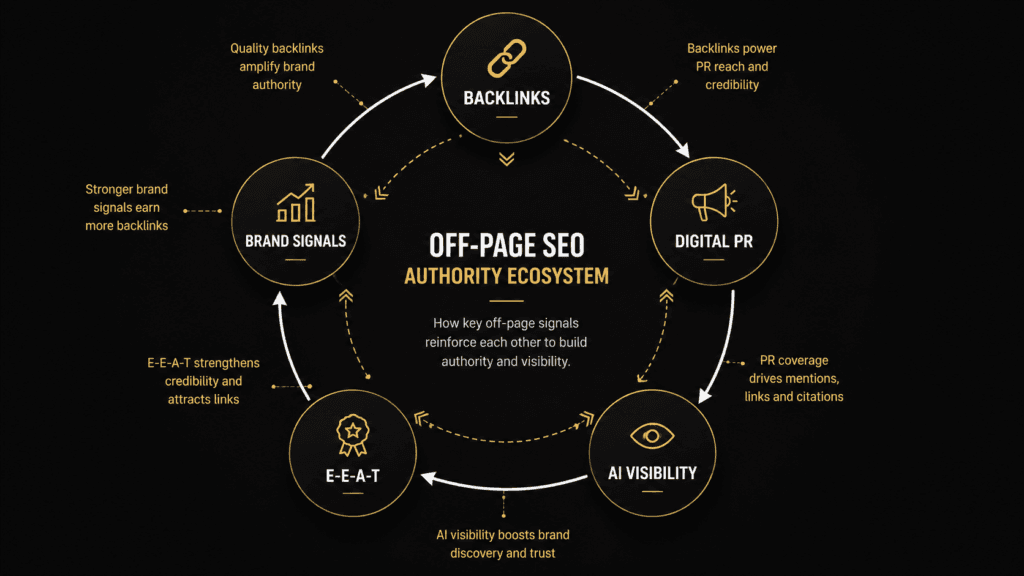
Off page SEO in 2026 is not one thing. It’s a system — and every component reinforces the others.
Here’s what a strategy that actually works looks like, without the noise:
Build link equity through link-worthy content, not link buying. Create one piece of content per quarter that is genuinely notable — original data, a definitive guide, a free tool, a contrarian perspective backed by research. Promote it directly to relevant publications and communities. This approach yields fewer links than mass outreach, but dramatically higher-quality ones.
Audit and stabilize your brand entity. Check your business name, address, and contact details across every directory, social platform, and citation source. Inconsistencies confuse Google’s entity recognition systems and quietly weaken your off-site presence. Consistency is a foundation, not a tactic.
Make brand mentions a measurement. Set up Google Alerts and use a brand monitoring tool to track where your brand is being mentioned across the web. When mentions appear without links, prioritize outreach to request attribution. A strong unlinked mention recovery campaign can build significant off page SEO value from opportunities that already exist.
Treat guest posting as relationship building, not link dropping. Writing genuinely valuable content for credible publications in your niche — not content mills, not “write for us” link farms — builds both editorial links and author entity signals. Quality and relevance above all.
Pursue media coverage like a newsroom. Produce at least one original data asset per year that journalists can reference. Survey your customers. Compile industry benchmarks. Publish a trend report. These create sustained citation opportunities that passive content never generates.
Track your off-page SEO performance honestly. Measure referring domain growth, brand mention volume, branded search trends, and AI citation frequency. Not just rankings. Rankings are the lag indicator. These are the lead indicators.
At Saga Creative Studios, we build marketing and SEO strategies that treat off-page authority as a deliberate craft — not a volume game. The brands that win in search aren’t outranking competitors by accident. They’ve built a digital reputation that Google has no choice but to reward.
Frequently Asked Questions
Q: What’s the difference between on-page SEO and off page SEO?
On-page SEO covers everything you control directly on your website — content quality, title tags, internal links, keyword usage, and page structure. Off page SEO covers external signals that influence how Google perceives your authority — backlinks, brand mentions, digital PR coverage, E-E-A-T validation, and AI citability. Both matter. Neither works alone.
Q: How long does off page SEO take to show results?
Off page SEO is slower than on-page work by nature. Editorial backlinks, brand signal accumulation, and E-E-A-T validation compound over months, not weeks. Expect meaningful ranking movement in three to six months for low-to-mid competition keywords, and six to twelve months for high-competition terms. The timeline shortens significantly once your site has established off-site authority — new content performs faster because the foundation already exists.
Q: Do brand mentions without links actually help off page SEO?
Yes — with an important qualification. Unlinked brand mentions help off page SEO by strengthening your entity’s topical associations in Google’s Knowledge Graph and contributing to AI citability signals. They do not pass PageRank the way backlinks do. The ideal outcome is a linked mention from a credible source. But unlinked mentions on high-authority sites still build measurable off-site authority — especially for branded search growth and AI visibility.
Q: Is E-E-A-T an on-page or off-page SEO signal?
Both — but the off-page validation is what makes it real. You can signal E-E-A-T on your own site through author bios, credentials, and structured data. But Google evaluates the credibility of those signals by cross-referencing what the broader web says about you. Third-party citations, media coverage, and expert recognition carry far more E-E-A-T weight than anything you publish about yourself.
The Bottom Line
Off page SEO in 2026 is a reputation system, not a link system.
Links still matter they matter a great deal. But they are one input into a much larger framework that includes brand signals, entity authority, E-E-A-T validation, digital PR coverage, and AI citability. Brands that understand this are building off-site authority that compounds and survives algorithm updates. Brands that don’t are running a link-acquisition treadmill that never quite reaches the finish line.
The shift is not subtle. It’s structural. And the earlier you rebuild your off page SEO strategy around what Google actually values in 2026, the harder it becomes for competitors to close the gap on you.
Stop counting links. Start building authority.
Founder of Saga Creative Studios. Nithish helps D2C and local brands in Bangalore grow on Instagram through reels, paid ads and content that converts.